


investor Info
Bionics Technology
Europe is facing a new supply-security environment driven by geopolitical tensions, Hormuz-related risks, fertiliser shortages, oil and gas dependency, climate stress and weakened soils. Bionic technology combines regional biomass conversion, µSoil fertiliser production, bio-oil, nitrogen retention, CO₂ storage, soil improvement and energy options in one industrial platform.
Particularly critical is the combination of fertiliser risk and water stress: if fertilisers become scarcer or more expensive while soils are simultaneously exposed to drought, yield and food price risks increase with a time lag. One mf200B plant can produce around 65,000 m³ of µSoil per year. At an application rate of 15–20 m³/ha, this represents a relevant regional contribution to substituting mineral fertiliser strategies and restoring degraded soils.
At the same time, with suitable configuration, the platform can operate with a high degree of energy autonomy, provide electricity and heat for defined consumers and contribute to grid stabilisation.
Because essential parts of the plants can primarily be manufactured, assembled and maintained in Europe, a rollout also creates industrial demand, secures existing jobs and generates new direct and indirect employment in plant engineering, automation, service, logistics and agriculture.
Executive Summary
Europe is entering a new phase of supply policy. Energy, fertilisers, food production, soil quality, CO₂ removal and industrial value creation can no longer be viewed separately. The Iran conflict and the restriction of the Strait of Hormuz show how quickly several critical supply chains can come under pressure at the same time: oil, LNG, fertilisers, ammonia, urea, sulphur, petrochemical precursors, logistics and agricultural production.
This situation should not be described in alarmist terms. It is not about panic, but about a foreseeable macroeconomic risk. If energy and fertiliser chains remain disrupted for a longer period, fertilisers may become scarcer, more expensive or available too late. The effect does not appear immediately in supermarkets, but with a time lag: in the fertilisation window, during the growing season, in the harvest and later in food prices. Short-term substitution is limited, because alternative sources are also tied to energy prices, production capacities, transport routes and international demand.
A climatic risk amplifier adds to this. Dry periods, irregular rainfall, heat waves and a possible El Niño event increase pressure on European agriculture. In this situation, it is not enough to discuss only the quantity of available fertiliser. The decisive question is whether soils can retain water and nutrients. Weakened, humus-poor or compacted soils lose nutrients more quickly, enter drought stress earlier and deliver less stable yields.
In this situation, Bionic technology emerges as an approach that connects several macroeconomic vulnerabilities:
| Macroeconomic problem | Bionic contribution |
|---|---|
| Import dependency for fertilisers | regional µSoil production and better use of organic nutrient streams |
| Oil and energy insecurity | bio-oil fractions, process gas, heat integration and optional power module |
| Nitrogen losses | nutrient retention, stabilisation and controlled release |
| Climate stress and water scarcity | improved water retention and soil structure through µSoil |
| Degraded soils | humus build-up, carbon matrix and restoration of soil fertility |
| CO₂ reduction | long-term carbon storage in biochar and soil |
| Industrial employment | European manufacturing, plant engineering, automation, service and logistics |
| Grid stability | dispatchable decentralised energy modules with storable energy fractions |
The particular macroeconomic value does not lie in one single function, but in the combination. Bionic is not merely a power generation solution, not merely a CO₂ sink, not a conventional compost concept and not an ordinary fertiliser project. The technology combines material production, soil improvement, fertiliser resilience, energy options, carbon storage and industrial value creation in one platform.
Unlike many climate-protection technologies, this approach is not designed as a permanent subsidy model. The plants generate marketable products in regular operation. The CO₂ sink effect arises additionally within a productive value chain. This makes Bionic one of the few CO₂-related technology approaches where climate impact, industrial production and positive operating cash flow can coincide.
A necessary rollout would also have a relevant industrial-policy effect. The plants can primarily be manufactured, assembled, automated, tested and maintained within European manufacturing and supplier structures. This creates demand for plant engineering, apparatus construction, stainless-steel processing, switchgear manufacturing, automation technology, microwave technology, service, laboratory analytics, logistics and technical operations management. A rollout therefore not only strengthens supply security, but also helps secure existing jobs and create new direct and indirect employment in Europe.
Europe needs a new class of industrial resilience technology
Energy, fertilisers, soil and CO₂ must be considered together
Europe is facing a supply situation that can no longer be described using the familiar categories of energy policy, agricultural policy, climate policy and industrial policy. The crises of recent years have shown that modern economies do not only depend on electricity and gas, but on complex material chains: oil products, fertilisers, ammonia, urea, phosphates, sulphur, chemical precursors, logistics, water, soil fertility and industrial production capacity.
The Iran conflict and the restriction of the Strait of Hormuz make this vulnerability visible. The Strait of Hormuz is not only a transport route for oil. It is a global bottleneck for energy, liquefied natural gas, fertilisers, petrochemical precursors and other critical material flows. If this corridor remains disrupted for a longer period, this does not create a single supply bottleneck, but a systemic shock.
Oil scarcity affects transport, agriculture, construction and logistics. Rising gas prices affect European ammonia and fertiliser production. Missing fertilisers do not immediately affect supermarket shelves; they first affect the fertilisation window, then the harvest and later food prices. Rising energy costs affect greenhouses, cold chains, processing, packaging and transport. At the same time, the state’s ability to respond is constrained by the accumulated burden of previous crises.
This coupling makes the situation more dangerous than a normal energy price crisis. Europe is not dealing with a single raw-material problem, but with an interconnected supply crisis.
The real weakness: dependency on linear import chains
Europe’s current supply systems are linear in many areas. Energy is imported, fertilisers are imported or produced from imported energy carriers, agricultural yields depend on external inputs, and many industrial precursors come from global supply chains.
As long as global markets function smoothly, this system appears efficient. In a geopolitical crisis, however, its weakness becomes visible: when a bottleneck emerges in one area, it propagates across several sectors.
| Bottleneck | Consequence |
|---|---|
| Oil and diesel | higher transport, harvest, logistics and construction costs |
| LNG and natural gas | higher energy prices and pressure on ammonia production |
| Ammonia and urea | fertiliser shortages and yield risks |
| Sulphur and phosphates | pressure on phosphate fertilisers and basic material chains |
| Petrochemical precursors | pressure on packaging, pharmaceuticals, plastics and industry |
| High electricity prices | shutdowns in energy-intensive industries |
| Logistics disruptions | delays, stockpiling, supply-chain breaks |
| Weakened soils | lower resilience to drought and weather extremes |
The result is a macroeconomic chain reaction. A fertiliser crisis becomes a food-security crisis. An oil crisis becomes a logistics crisis. A gas price crisis becomes an industrial and fertiliser crisis. A soil crisis becomes a water and yield crisis.
This is precisely why isolated responses are no longer sufficient.
Iran conflict, fertilisers and food prices: a delayed risk
The Iran conflict and the restriction of the Strait of Hormuz must not be understood only as an energy problem. The bottleneck also affects fertilisers, ammonia, urea, sulphur, LNG and petrochemical precursors. The crisis therefore has both direct and indirect effects on agriculture.
The direct channel concerns fertiliser imports and precursors. The indirect channel runs through energy prices: nitrogen fertiliser depends on natural gas, ammonia and energy-intensive production. If gas and transport costs rise, or if supply routes fail, the costs and risks of fertiliser supply also increase.
The particular feature of agriculture is the time lag. Missing or overly expensive fertiliser does not act like an immediate power outage. The effect occurs during the fertilisation window, in plant development and later in the harvest. If farmers postpone, reduce or omit fertiliser applications for cost reasons, the yield decline may only become visible months later. By then, however, the damage can no longer be corrected at short notice.
For this reason, the situation should not be treated as acute panic, but as a structural precautionary risk. If energy and fertiliser chains remain disrupted for longer, substantial food price increases may follow. Short-term replacement is hardly available, because alternative fertiliser sources are also dependent on energy prices, production capacity, transport routes and international demand.
For Europe, the conclusion is clear: agriculture needs additional regional nutrient pathways that are not fully dependent on gas-based mineral fertiliser production and global sea routes. µSoil can close part of this gap because it combines regional biomass, organic nutrient streams and Bionic biochar into a functional soil and fertiliser product.
El Niño, drought and soil water: the underestimated risk amplifier
In addition to energy and fertiliser risks, another factor is gaining importance: the increasing uncertainty of water availability. Europe must prepare for longer dry periods, more irregular rainfall, heat waves and stronger regional water stress. A possible El Niño event further increases this uncertainty because it can influence global temperature, precipitation and harvest patterns.
For agriculture, this means that the critical question is not only whether enough fertiliser is available. The decisive point is whether the soil can retain water and nutrients at all. On weakened, humus-poor or compacted soils, nutrients are lost more quickly, plants enter drought stress earlier, and yields become more volatile.
Soil water therefore becomes a macroeconomic resilience factor. A fertiliser strategy that relies only on mineral nutrient applications falls short under these conditions. Europe needs soil products that stabilise nutrients, retain water in the root zone and make degraded soils more resilient again.
This is precisely where the strategic value of µSoil lies. µSoil combines nutrient supply with a carbon matrix that supports water retention, soil structure and biological activity. As a result, not only the plant is fertilised; the soil itself becomes more resilient to drought, heat and nutrient losses.
Why conventional crisis instruments are not enough
Emergency reserves, import diversification, new supply contracts and state price support remain important instruments. They can buy time. But they do not create structural independence.
Oil reserves do not replace a permanent regional energy option. LNG terminals broaden procurement options, but remain tied to global market prices and transport routes. Fertiliser imports can help in the short term, but remain dependent on gas prices, export policy, sea routes and geopolitical risks. Pure emission rules can reduce environmental burdens, but do not create new regional nutrient cycles. Pure CO₂ removal technologies can store carbon, but do not solve fertiliser, soil or energy problems.
Europe therefore needs a new class of technologies: industrial platforms that fulfil several critical functions at the same time.
The decisive question is no longer:
How do we solve energy, fertiliser, CO₂, nitrogen and soil separately?
But rather:
Which technologies can address these problem fields together while operating economically?
The Bionic approach
An industrial platform instead of a single-purpose technology
The Bionic mf200B is an industrial platform for converting regional biomass into defined product streams. It produces biochar, µSoil, bio-oil fractions, process gas, organic acids and further material fractions. The result is not one single product, but a combined materials, energy, soil and carbon platform.
The plant should therefore not be understood as a conventional power plant. Nor is it merely a recycling, composting or CO₂ project. Its macroeconomic value results from its multiple effects:
- regional biomass is converted industrially,
- fertiliser and soil products are produced locally,
- bio-oil and process gas create storable energy options,
- carbon is stored long-term in biochar and soil,
- nitrogen losses can be reduced,
- European manufacturing and service chains are activated.
This combination makes the technology particularly relevant in the current situation. Bionic does not merely contribute to a single policy objective, but connects several target areas that are already linked from a macroeconomic perspective.
How the mf200B works technically
The Bionic mf200B does not operate like a conventional externally heated pyrolysis plant. In conventional systems, biomass is usually heated via hot reactor walls or hot gases. This creates temperature gradients: hot on the outside, cooler inside. The result can be uneven reaction zones, longer vapour residence times, stronger secondary reactions and fluctuating product qualities.
Bionic technology instead uses microwave-assisted process control. Energy is coupled directly into the material matrix. This allows the biomass to be heated volumetrically. In combination with vacuum operation, inert conditions, rapid vapour removal and staged condensation, this creates a controlled reaction window.
Inside the reactor, pelletised biomass is converted under oxygen exclusion and vacuum into several product streams. The process is designed for continuous industrial operation. The microwave sources are individually monitored and controlled. Reflection measurement, tuners, circulators, arc detection, temperature monitoring, online gas measurement and supervisory process control help keep the reaction stable and reproducible.
The result is not an undefined mixed fraction, but a structured product pathway:
| Product stream | Function |
|---|---|
| Bionic biochar / µChar | carbon carrier for µSoil, CO₂ sink and potential specialty materials |
| Bio-oil fractions | material use, energy option and storable energy carrier |
| Process gas | internal heat and energy integration |
| Organic acids and condensates | additional material product pathways |
| Heat and ORC potential | self-supply and optional energy integration |
The central agricultural value lies in the biochar produced. It is not merely a by-product, but the functional basis for µSoil. From the microwave-based carbon matrix, a soil product is created that combines nutrient supply, water retention, soil biology and long-term carbon storage.
µSoil: fertiliser resilience begins in the soil
More than compost, more than fertiliser
At the centre of the Bionic logic is µSoil. µSoil is not a simple compost and not an ordinary organic fertiliser, but a functional 12/12/12 soil improver that combines nutrient supply, soil build-up, water management and carbon storage.
Its basis is the highly porous Bionic biochar from the mf200B. This carbon matrix can stabilise nutrients, water and microorganisms in the soil. This creates a fertilisation system that not only supplies nutrients in the short term, but improves soil as a production factor.
One mf200B plant can produce around 65,000 m³ of µSoil per year. At a typical application rate of 15–20 m³/ha, this represents a relevant regional contribution to supplying agricultural land. The technology should therefore not be regarded merely as a niche specialty product, but as an industrially scalable building block for regional fertiliser and soil resilience.
Substitution of mineral fertiliser strategies
µSoil can functionally substitute mineral fertiliser strategies in suitable applications. The decisive factor is not only the nutrient content, but the better usability of nutrients in the soil. While conventional mineral fertilisers are often rapidly soluble and can be partly lost under unfavourable weather, soil or management conditions, the carbon matrix of µSoil retains nutrients longer in the root zone.
For agricultural operations, the decisive question is not only how much nutrient is applied, but how much of it actually remains plant-effective. Higher nutrient efficiency reduces dependency on mineral supplementation. In a situation where mineral fertilisers may become expensive, scarce or geopolitically insecure, this is a strategic advantage.
The µSoil logic therefore differs fundamentally from a purely mineral fertiliser application:
| Conventional mineral fertilisation | µSoil logic |
|---|---|
| rapid nutrient application | longer-term nutrient provision |
| higher leaching risk | stronger retention in the root zone |
| no significant soil-structure effect | build-up of carbon matrix and humus function |
| repeated application requirement | lower workload due to long-term effect |
| dependent on gas, ammonia and import chains | regional production from biomass and nutrient streams |
The macroeconomic difference is substantial: µSoil does not only address the fertiliser market, but also soil fertility, water management, nitrogen losses, CO₂ storage and agricultural crisis resilience.
Improvement of water management
The porous carbon structure in µSoil can improve soil water management. Water is stored better in the soil and remains available to plants for longer. Particularly on sandy, humus-poor, compacted or damaged soils, this can increase resistance to dry periods.
This property becomes more important as climate risks increase. Europe must expect longer dry periods, irregular precipitation, heat waves and heavy rainfall events. Soils that can store water more effectively are more productive and stable under such conditions.
µSoil therefore acts not only as a fertiliser, but as a soil-based climate adaptation instrument.
Water resilience as part of food security
Water resilience is becoming a central component of food security. In dry years, yield does not depend only on the available amount of fertiliser, but on the soil’s ability to retain water and nutrients in the root zone.
µSoil can make a dual contribution here. First, the porous carbon matrix improves the storage of plant-available water. Second, nutrients are more strongly bound to the soil matrix and are less quickly leached or lost unused. This combination is particularly important under irregular rainfall: the soil can buffer water more effectively and keep nutrients available for longer.
µSoil therefore acts not only as a fertiliser substitute, but as an adaptation tool for drier and more volatile climate conditions. For farms, this means greater stability in difficult years. For the economy as a whole, it means lower vulnerability of domestic food production to simultaneous fertiliser, energy and weather risks.
Yield potential and more stable plant development
µSoil can support yield performance because several effects coincide: better nutrient availability, more stable water management, improved soil structure, microbiological activity and lower nutrient losses.
The effect does not arise from short-term over-fertilisation. It arises from a more stable root-zone environment. Plants can absorb nutrients more evenly, react less sensitively to drought stress and benefit from improved soil structure.
From a macroeconomic perspective, this is important because food security does not only come from imports and storage. It begins with the stability of domestic yields.
Lower fertilisation workload
For farms, fertilisation is not only a material issue. It is also a labour, machinery, timing and logistics issue. Liquid farm fertilisers or mineral fertiliser strategies often require several application dates, narrow weather windows, machinery availability and additional field passes.
µSoil can be applied as a long-term soil product at larger intervals. This can reduce field passes, lower soil compaction and simplify fertilisation planning. This is particularly relevant during labour-intensive seasonal windows.
| Effect | Practical benefit |
|---|---|
| longer nutrient effect | fewer time-critical fertiliser applications |
| better nutrient retention | lower losses and more efficient use |
| better water retention | greater stability in dry periods |
| fewer field passes | lower workload and less soil compaction |
| soil build-up | long-term improvement of the production factor soil |
Restoration of degraded and denatured soils
Particularly important is the contribution to the regeneration of degraded or denatured soils. Many areas have lost fertility due to humus depletion, compaction, intensive use, nutrient leaching, erosion or drought stress. Such soils need more than a short-term nutrient application. They need structure, organic matter, water retention capacity, microbial activity and stable carbon carriers.
µSoil addresses precisely this point. The soil is not only fertilised, but gradually rebuilt. The carbon matrix improves structure, organic matter supports humus build-up, biological activity improves soil function, and nutrients become more evenly available.
In a European agricultural landscape where soil quality is increasingly becoming a limiting factor, this is of high macroeconomic importance. Soil fertility is not a short-term input. It is productive capital.
Nitrogen: from emissions problem to resource
Nitrogen is indispensable for agriculture. At the same time, it is one of Europe’s largest environmental problems. Nitrogen can escape into the air as ammonia, enter groundwater as nitrate or become climate-relevant as nitrous oxide.
Until now, this problem has often been addressed through restrictions: lower application volumes, narrower time windows, stricter rules and more documentation. These instruments may be necessary, but they create conflicts because they restrict agricultural production without automatically creating new value.
Bionic offers a different approach. Nitrogen should not only be limited, but productively retained and used more effectively. A particularly interesting solution space emerges in combination with biogas plants.
Digestate is nutrient-rich, but in liquid form it is difficult to transport, prone to losses and problematic from a regulatory perspective. Through Bionic µChar and subsequent µSoil upgrading, this digestate pathway can be transformed into a solid, more controllable biofertiliser.
| Current logic | New logic with Bionic |
|---|---|
| digestate as application problem | digestate as raw material for biofertiliser |
| nitrogen losses | nitrogen retention and controlled release |
| regulatory pressure | productive nutrient recovery |
| liquid bulk logistics | more manageable solid soil product |
| local burden | regional value creation |
This is politically relevant because it can ease the conflict between agriculture and environmental policy. Nitrogen is no longer treated only as a problem, but recovered as a resource.
Bio-oil, process gas and energy options
Storable energy instead of volatile surplus
The Bionic plant produces bio-oil fractions and process gas. These streams are not merely by-products. They create a storable energy and material option.
In normal markets, bio-oil fractions can be used materially or industrially. In strained supply situations, they can also become regionally available energy and heat reserves.
The key point is storability. Liquid energy carriers can be stored, transported and deployed according to priority. This distinguishes them from fluctuating electricity generation and short-duration storage systems. In a supply crisis, storability itself becomes a strategic value.
Optional power module: energy and grid resilience as an additional function
The Bionic mf200B remains, in its basic logic, a plant for producing µSoil, biochar, oil fractions and further material streams. The optional power module does not change this primary function. It expands the site by adding an additional level of supply security.
The µOil produced in the process can be used in normal operation as a material stream or as a fuel component. In a crisis or resilience configuration, the same material stream can be used for local electricity and heat supply. This does not turn the Bionic plant into a conventional power plant, but into an industrial materials site with an optional energy and balancing-power function.
With appropriate design, the power module can consist of several functional units:
| Functional unit | Task |
|---|---|
| Fuel conditioning | conditioning, blending, filtration and supply of oil fractions |
| Generator block | conversion of oil fractions into dispatchable electrical power and heat |
| Supercaps | very fast response in the first seconds for frequency support |
| Battery | bridging until generators take over load |
| Grid and protection technology | safe feed-in, switching, island operation and prioritisation |
| Heat utilisation | use of exhaust and cooling-water heat for heating circuits or thermal storage |
The technical logic follows a staged response. First, supercaps provide the very fast regulation response. Then a battery takes over the bridging function. In parallel, a preheated generator is connected. Additional generators can follow until the required block power is reached. This combines fast electrical response with longer available energy.
In an example configuration, a power module can be built with three generators of 4 MW each. The important point is the correct interpretation: such a module is not intended for year-round continuous operation from internal oil fractions, but for balancing power, standby operation, municipal resilience applications, targeted continuous-load windows and the protection of defined consumers.
Energy autonomy and municipal added value
With an appropriate basic design, the Bionic plant can achieve a high degree of energy self-supply. Process gas, bio-oil fractions, heat integration, ORC, storage technology and intelligent control can be combined so that the site not only produces products, but also provides energy and heat resilience.
For municipalities, commercial areas and industrial sites, this creates several additional benefits:
| Benefit level | Meaning |
|---|---|
| Self-supply | plant operation can be secured, with suitable design, even during external grid disturbances |
| Municipal resilience | electricity and heat can be provided to defined local consumers |
| Critical infrastructure | prioritised supply of particularly important consumers becomes technically feasible |
| Balancing power | fast response to grid frequency and load fluctuations |
| Heat extraction | usable waste heat can support local heat supply |
| Island operation | with suitable protection and grid technology, a site can temporarily operate decoupled from the public grid |
This function becomes particularly relevant in power grids with a high share of wind and photovoltaics. The more fluctuating feed-in increases, the more important decentralised dispatchable units, storage systems, fast-response systems and local heat utilisation become. The optional Bionic power module can act as a regional flexibility component in this context.
The boundary must remain clear: the commercial foundation and primary task of the mf200B lie in µSoil and material-stream operation. The power module is a strategic extension for sites where supply security, balancing power, heat extraction or municipal resilience are politically and technically relevant.
CO₂ sink with productive value creation
Many CO₂ sinks are perceived as cost blocks. They have to be financed, subsidised or permanently supported through certificates. The Bionic logic is different.
The plant generates marketable products in regular operation: µSoil, bio-oil fractions, biochar, process gas, organic acids and further material fractions. The CO₂ sink effect does not arise in isolation, but as part of this value chain.
Biogenic carbon is bound in stable biochar, introduced into soils via µSoil and stored there long term. At the same time, improved nutrient efficiency, lower leaching, reduced nitrogen losses and partial substitution of energy-intensive mineral fertilisers can reduce further emission pathways.
This makes Bionic one of the few approaches where CO₂ storage, product economics and industrial scalability can coincide. The technology is not designed as a permanent subsidy model. Public programmes may accelerate the rollout, but the economic basis rests on real product streams and operational value creation.
This is decisive for the economy as a whole. Climate protection becomes more politically viable when it does not only create costs, but also supply security, regional production, employment and industrial value creation.
Decentralised plants instead of centralised vulnerability
Bionic is not designed as one large central plant that bundles all risks in one location. The approach is suitable for regional site networks close to biomass, agriculture, municipalities, commercial areas and heat consumers.
This decentralised structure has macroeconomic value because it reduces several dependencies:
| Decentralised effect | Macroeconomic benefit |
|---|---|
| short material routes | less transport dependency and lower logistics risks |
| regional biomass use | value creation remains in the region |
| local fertiliser production | less import and price dependency |
| local energy options | better crisis capability for municipalities and industry |
| technical jobs | operation, maintenance, service, laboratory and logistics |
| lower systemic vulnerability | failure of individual sites does not endanger the overall system |
| regional soil improvement | long-term stabilisation of agricultural production capacity |
Bionic therefore fits into a European model of regions: rural areas become not only raw-material suppliers, but operators of industrial resilience infrastructure.
European manufacturing and employment effect
A larger rollout of Bionic technology would have not only a supply-policy dimension, but also an industrial-policy dimension. The plants are not designed as import-dependent black-box technology, but as industrial plants that can be manufactured in Europe.
Essential parts of mechanical manufacturing, stainless-steel and apparatus construction, skid assembly, automation, switchgear, piping, commissioning and later maintenance can be implemented within European industrial and supplier structures.
A rollout therefore creates demand for European manufacturing capacity. The technology requires qualified supply chains, serial production, assembly capacity, electrical and automation technology, plant service, spare-parts supply, quality assurance and technical operations management.
| Employment field | Direct and indirect effect |
|---|---|
| Plant and apparatus construction | manufacturing of reactors, skids, vessels, piping and auxiliary systems |
| Stainless-steel and mechanical engineering | high-quality mechanical components and process-related assemblies |
| Electrical and automation technology | switch cabinets, sensors, HMI, PLC/DCS, safety technology |
| Microwave and high-frequency technology | magnetron modules, waveguides, tuners, power electronics and measuring systems |
| Assembly and commissioning | FAT, SAT, site integration, ramp-up and operator training |
| Maintenance and service | spare parts, preventive maintenance, remote diagnosis and lifecycle service |
| Laboratory and quality assurance | feedstock testing, µChar analytics, µSoil quality and product release |
| Regional logistics | biomass acceptance, pelletising, product storage and delivery |
| Agricultural application | application, advisory services, soil management and distribution partners |
This employment effect distinguishes Bionic from many purely digital or import-driven climate solutions. The technology creates real industrial value: machines, components, service, operation, logistics and regional products.
At a time when parts of European industry are under pressure from high energy prices, volatile raw-material markets and global supply-chain risks, this point is politically important. A Bionic rollout can utilise existing European manufacturing structures, secure existing jobs and create new qualified employment.
The macroeconomic context
From a macroeconomic perspective, the value of Bionic technology does not lie only in the individual plant. It lies in reducing systemic dependencies.
| Macroeconomic lever | Effect |
|---|---|
| Import substitution | lower dependency on fossil and mineral input chains |
| Price stabilisation | less exposure to global energy and fertiliser prices |
| Supply security | regional availability of soil products, energy options and material streams |
| Agricultural resilience | more stable soils, better water management, lower mineral fertiliser need |
| Climate impact | CO₂ storage without a purely cost-driven character |
| Industrial policy | European manufacturing and employment |
| Regional value creation | revenues, jobs and infrastructure in rural areas |
| Grid stability | decentralised dispatchable energy options |
| Environmental relief | lower nitrogen losses, less nutrient leaching |
This creates multiple macroeconomic benefits. The plant produces products, reduces risks, strengthens regions, creates industrial demand and supports climate targets. This combination will become more important politically in the coming years than isolated individual measures.
Why this solution space is opening now
In stable times, energy, fertiliser, soil, water, CO₂ and industrial policy are often treated separately. In times of crisis, it becomes clear that they belong together.
A fertiliser crisis is also an energy crisis. An oil crisis is also a logistics crisis. A soil crisis is also a water and food-security crisis. A CO₂ sink without a business model remains difficult to scale. An energy technology without material use does not solve nutrient problems.
Bionic addresses exactly this intersection.
The technology does not become relevant because it serves a single political keyword, but because it acts where several bottlenecks arise at the same time:
- regional fertiliser production,
- better use of organic residual and nutrient streams,
- bio-oil as a storable energy carrier,
- process heat and optional electricity provision,
- nitrogen retention and lower losses,
- soil improvement and water retention,
- CO₂ storage in a stable carbon matrix,
- industrial manufacturing and employment in Europe.
This combination is rare in this form. This is precisely why the current European situation creates growing demand for such platform technologies.
Political classification
For political decision-makers, it is important that Bionic is not understood as an individual subsidy project. The approach should be classified as an industrial resilience platform that touches several policy areas at the same time.
| Policy field | Relevance of Bionic technology |
|---|---|
| Food security | more stable soil fertility and lower fertiliser dependency |
| Energy policy | storable bio-oil fractions, process gas, heat and optional electricity provision |
| Climate policy | CO₂ storage in biochar and soil |
| Agricultural policy | lower nutrient losses, better soil structure and reduced workload |
| Environmental policy | reduction of nitrogen losses and water pollution |
| Industrial policy | European manufacturing, plant engineering, service and jobs |
| Regional policy | decentralised value creation and technical infrastructure in rural areas |
| Power system | decentralised dispatchable energy modules and grid stabilisation |
Policy does not need to permanently subsidise such technologies, but it must create the framework conditions that allow them to be tested, approved, standardised, financed and scaled quickly.
This includes clear permitting pathways, technical standards, product certification, integration into regional energy and agricultural concepts, and recognition of CO₂, soil and nitrogen benefits in suitable regulatory systems.
Conclusion
The Iran conflict and the restriction of the Strait of Hormuz show how quickly energy, fertiliser, agricultural, industrial and food chains can enter a common stress situation. Europe cannot solve this vulnerability solely through new import contracts, emergency reserves or short-term price support.
The strategic task of the coming years will be to build regional cycles that connect energy, fertilisers, soil quality, nitrogen reduction and CO₂ storage.
Bionic technology offers an approach that will gain importance from the situation itself. It processes regional biomass, produces µSoil, stores carbon, stabilises nutrients, supplies bio-oil fractions and creates regional industrial value. In combination with existing biogas and agricultural structures, it can also provide an entry point into productive nitrogen recovery.
Particularly critical is the combination of fertiliser risk and climate stress. If mineral fertilisers become scarcer or more expensive while drought, heat or irregular rainfall increase at the same time, a double yield risk emerges. This is why supply security must begin in the soil. µSoil combines nutrient supply, water retention, soil regeneration and carbon storage. This makes the soil itself more resilient to the coming stresses.
The decisive difference is that this CO₂ sink is not designed as a permanent subsidy case. The plant generates marketable products in regular operation and can create positive operating value. Bionic therefore combines climate impact, fertiliser resilience, energy options and economic viability.
With suitable configuration, Bionic sites can operate with a high degree of energy autonomy, supply external consumers with electricity and heat, and provide balancing energy to stabilise the power grid.
Bionic also has an industrial-policy dimension. The plants can primarily be manufactured, assembled, tested and maintained within European manufacturing and supplier structures. The necessary rollout therefore not only creates resilience in fertilisers, energy, soil and CO₂, but also demand for European plant engineering, automation, microwave technology, service, laboratory work, logistics and technical operations management.
Bionic thus stands for a new class of industrial resilience technology: not as a single answer to a single problem, but as a platform for several of Europe’s most pressing supply questions — fertilisers, energy, soil, nitrogen, CO₂, grid stability and industrial value creation.
International Presence
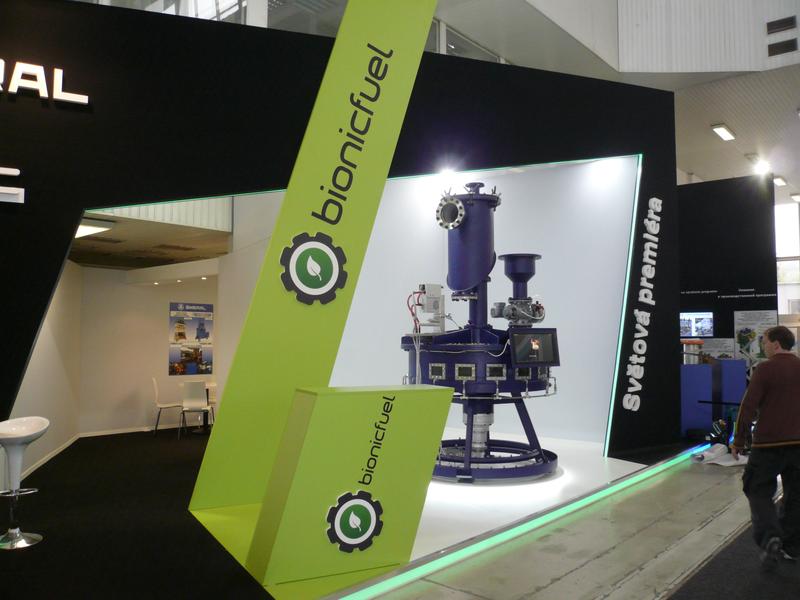
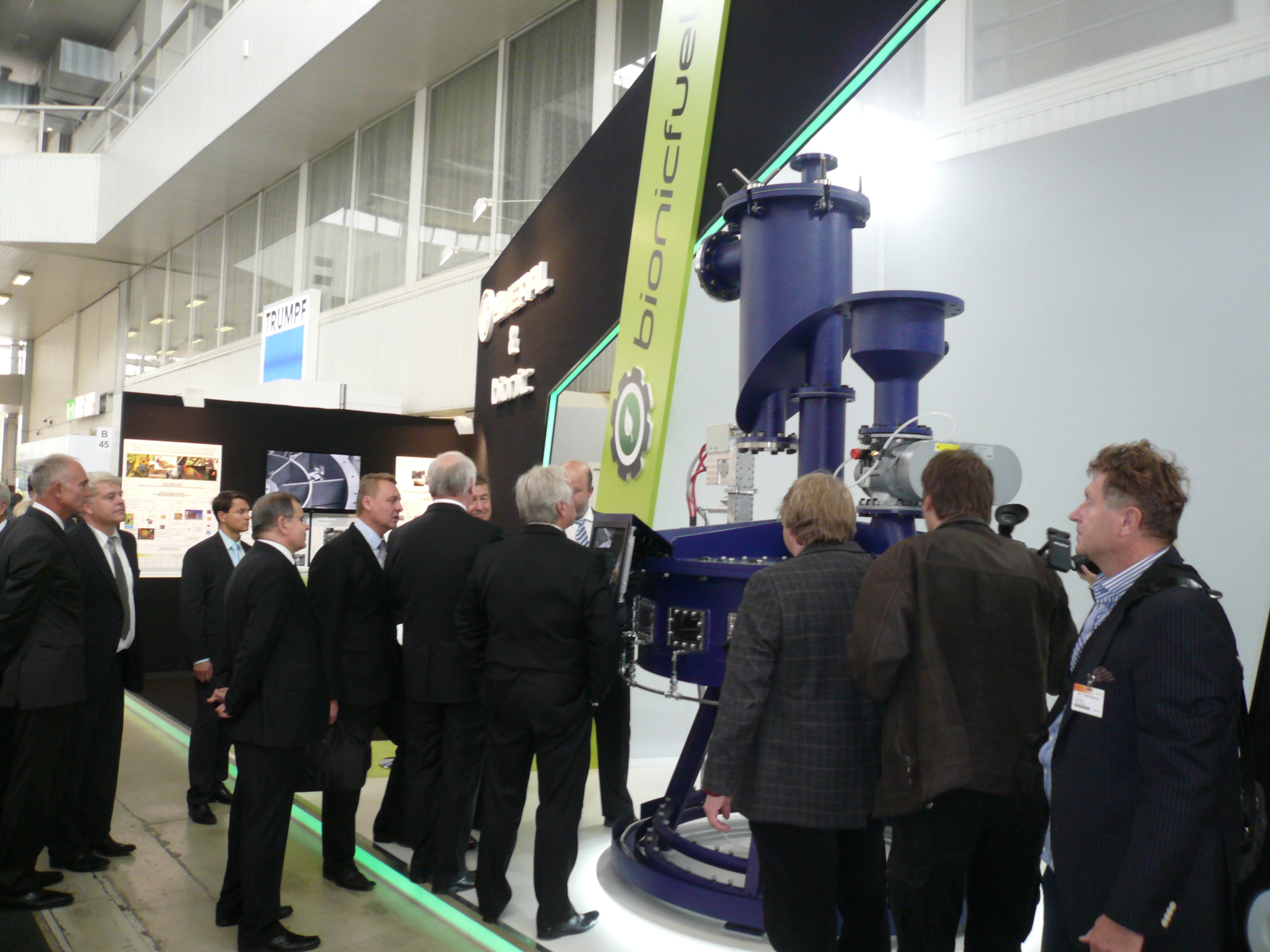
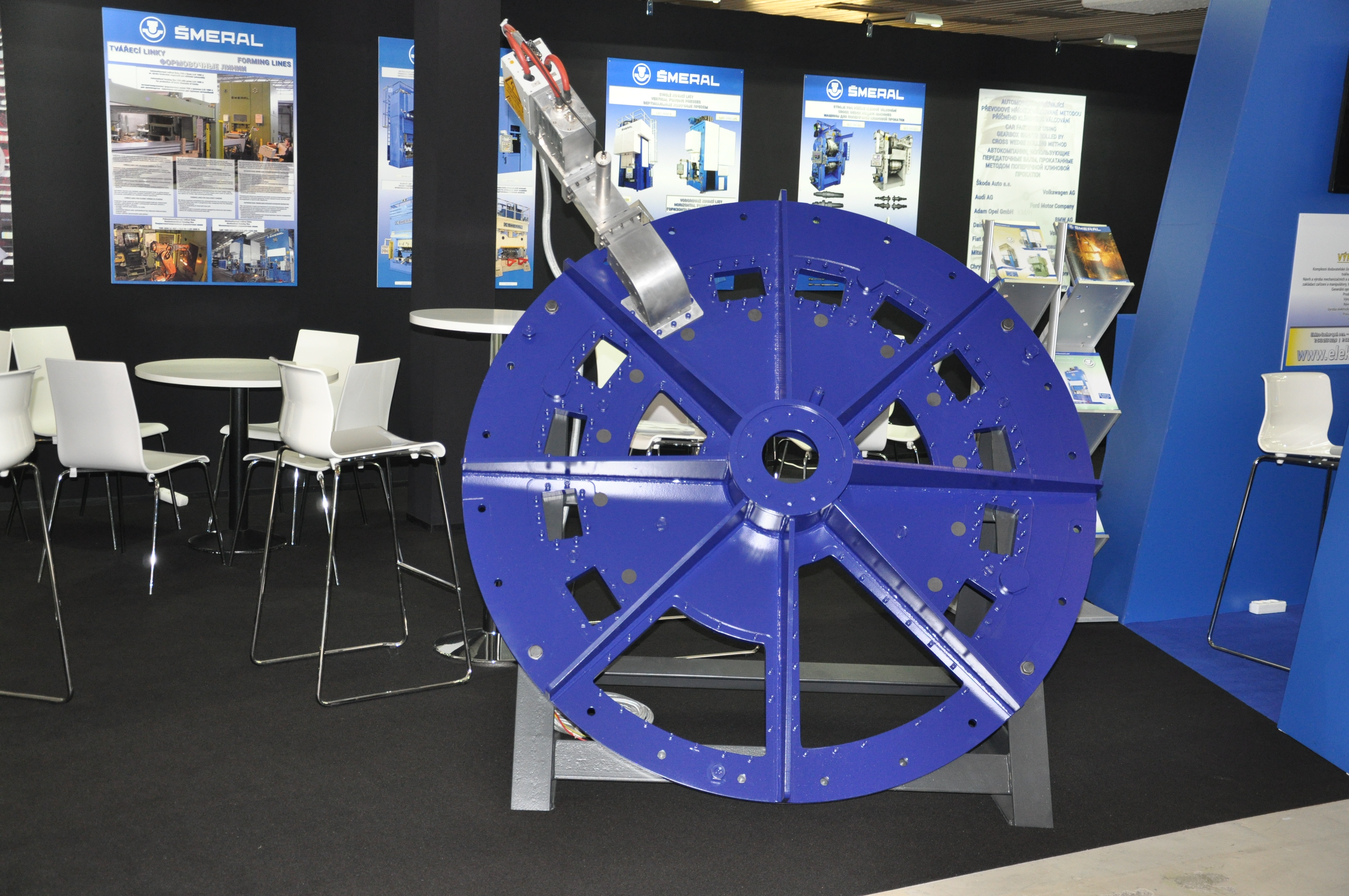
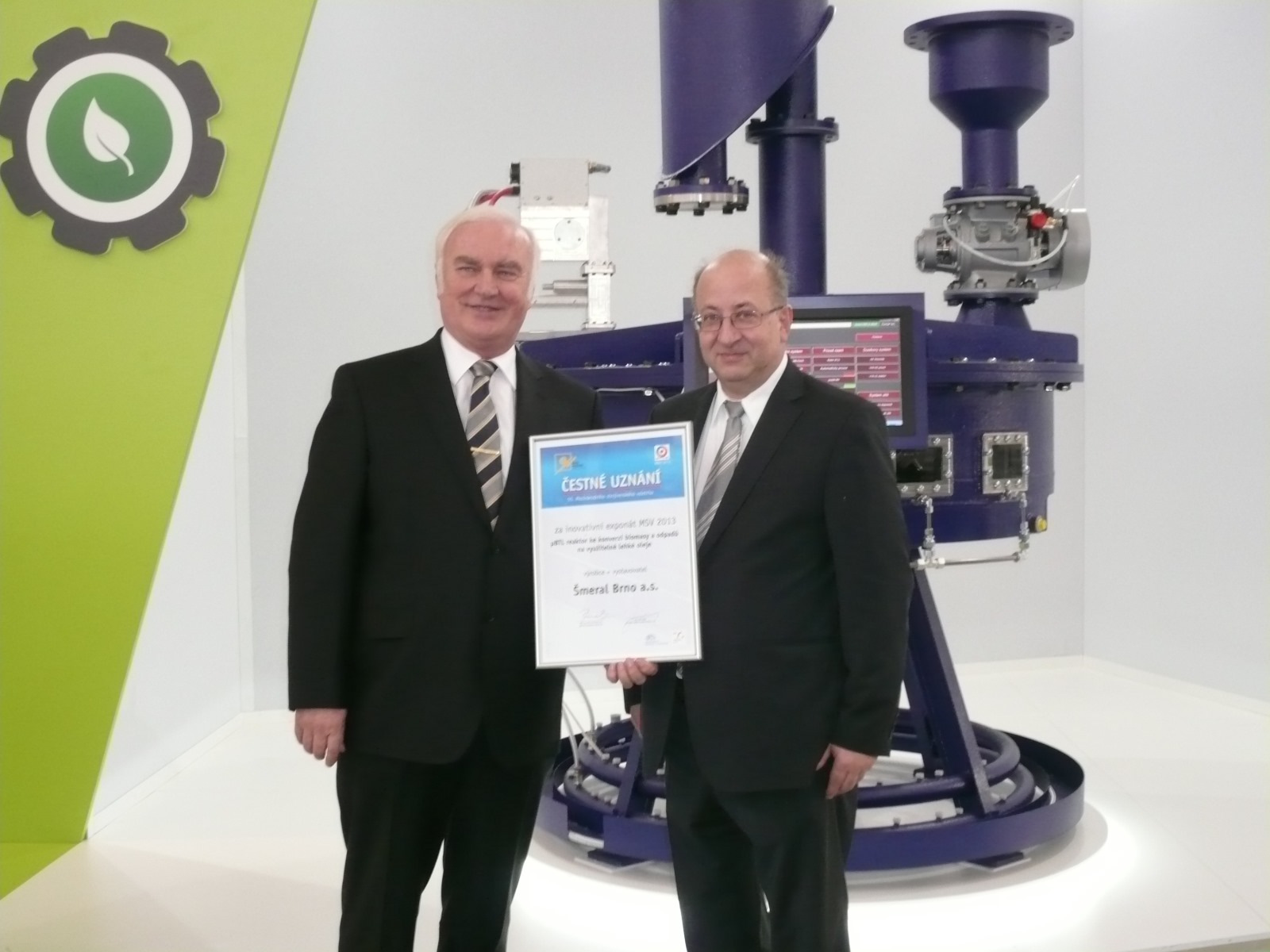
Bionic first gained international recognition at the MSV International Technical Exhibition in Brno, Czech Republic, in 2013. In the same year, we successfully established our Demonstration Plant mf60 in Brno, CZ. This breakthrough technology was honored with the Innovation Award of the MSV Exhibition and Ministry of Industry of Czech Republic for best new Technology 2013 to Smeral A.S., an award shared with Bionic's Czech Manufacturer and Exhibitor, Smeral a.s.
.jpg)
Innovation award
Report in Czech prime time Television